The model
AI9GM numbers layers by dependency, not by importance. Weakness lower in the stack constrains every layer above it, and weakness higher in the stack leaves every layer below it without direction. Layer 6 is not the destination of the model and Layer 1 is not every organization's starting point (AI9GM-v0_9.md section 0.1).
Layer 1
Foundation
The Digital Backbone
Can it run?
Provide and operate the compute, storage, network and service capacity that every layer above depends on, at a level of availability and performance that AI workloads can be planned against.
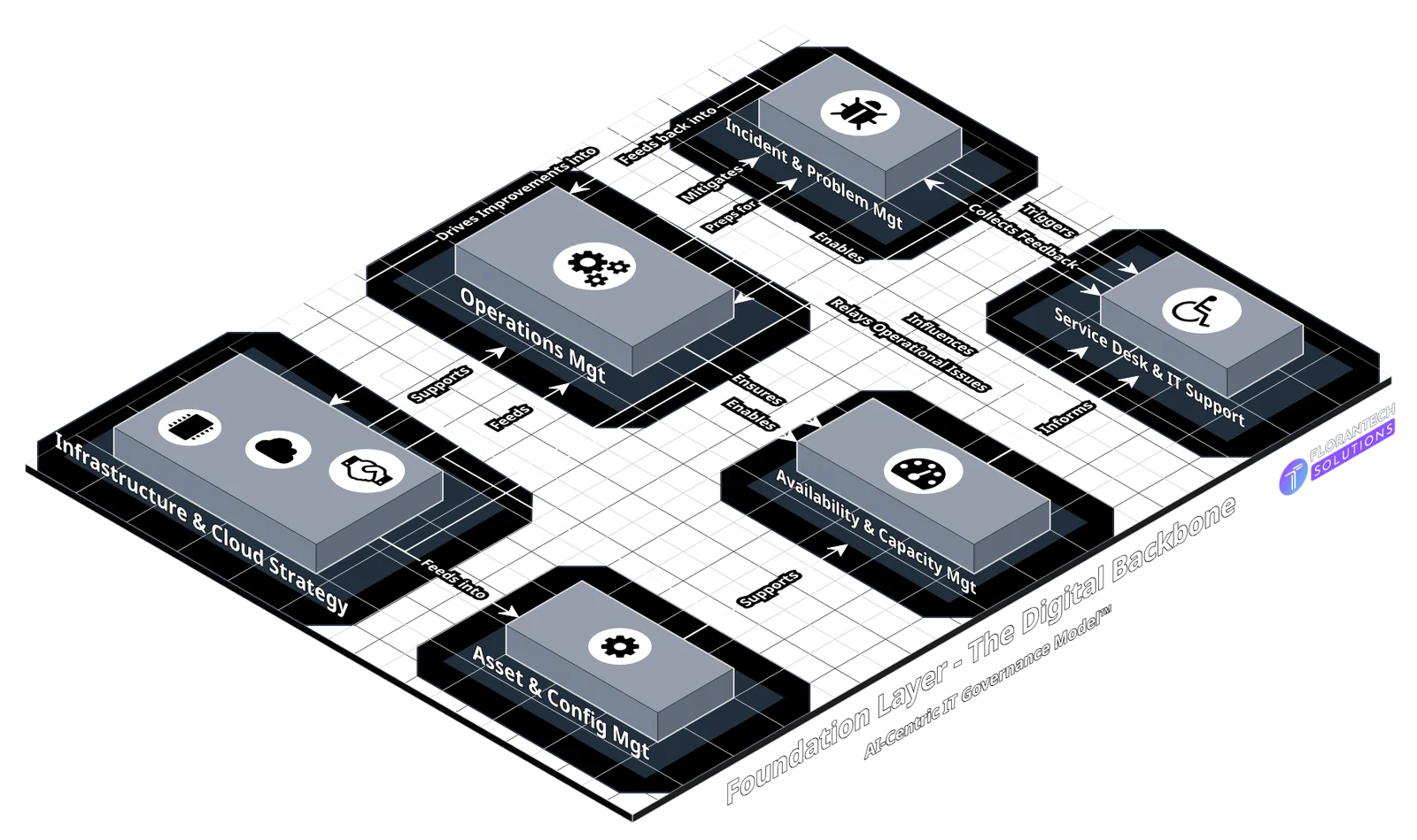
Layer 1 Focus Areas
Infrastructure and Cloud Strategy
L1-FA-01
On-premise, cloud and hybrid placement, capacity architecture, accelerator provisioning.
Asset and Configuration Management
L1-FA-02
Asset tracking, CMDB, lifecycle management. Models and datasets are configuration items.
Operations Management
L1-FA-03
Monitoring, maintenance, automation, DevOps and SRE practice.
Availability and Capacity Management
L1-FA-04
Uptime, performance, disaster recovery, capacity forecasting.
Incident and Problem Management
L1-FA-05
Incident resolution and root cause elimination.
Service Desk and IT Support
L1-FA-06
User support, ticketing, service levels, self-service.
Why it matters for AI
AI workloads make demands that ordinary application infrastructure was not sized for. A weak Foundation layer does not degrade the layers above it gracefully. It caps them.
Layer 2
Structural
The Digital Fabric
Can it connect?
Connect enterprise systems under declared contracts so process and data move between them, and maintain the architecture standards that determine what gets built and with what.
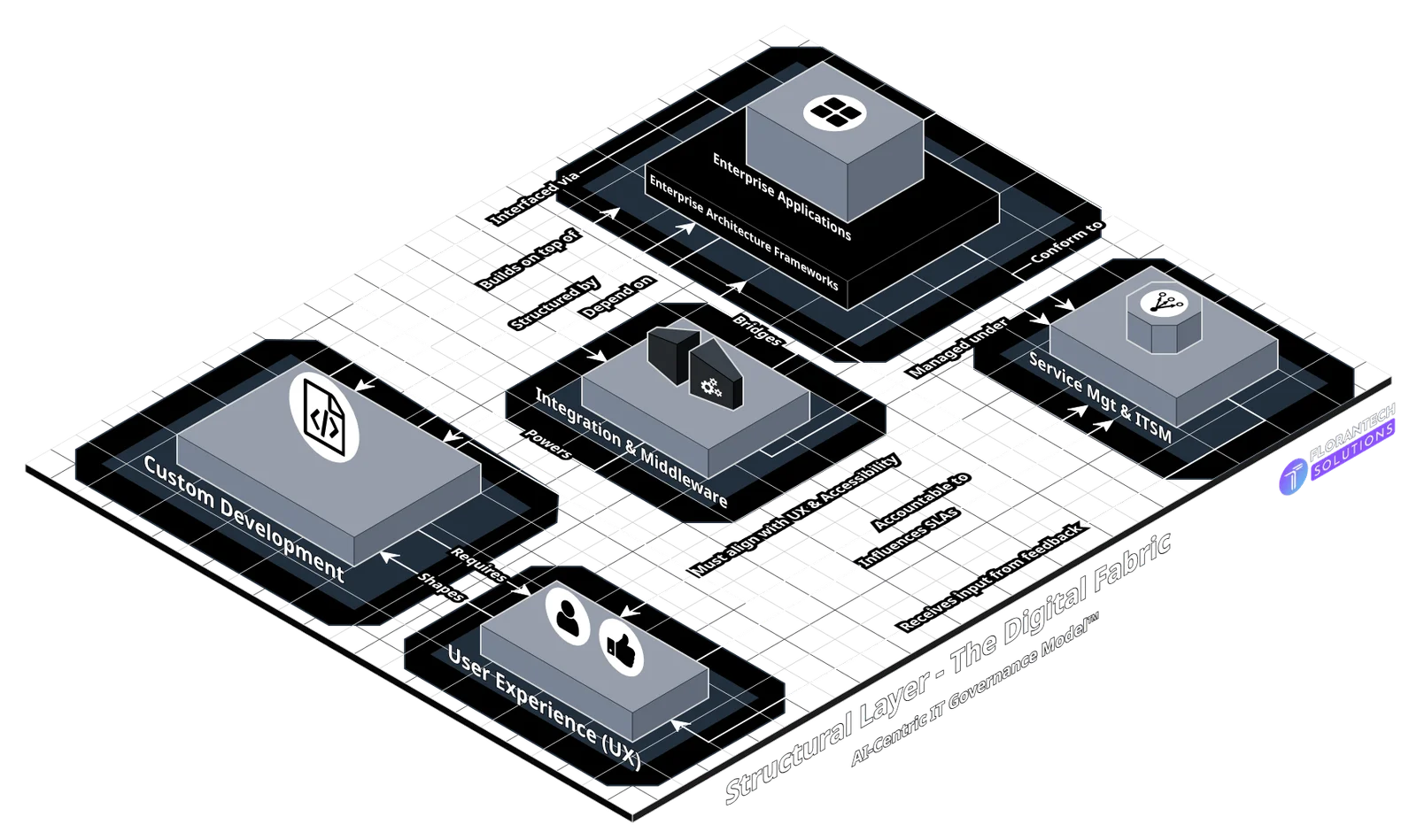
Layer 2 Focus Areas
Enterprise Applications
L2-FA-01
ERP, CRM, SCM, HRMS and other business-critical systems.
Custom Software Development
L2-FA-02
Internal and external engineering. Where AI assists development, delivery governance is held by STRATA Protocol: project classification at Stratum 1, the copilot authority chain at Stratum 3 and the artifact trail at Stratum 5. AI9GM does not restate these.
Application Lifecycle Management
L2-FA-03
Development, testing, deployment, maintenance.
Integration and Middleware
L2-FA-04
API management, service orchestration, microservices, event transport.
User Experience, Accessibility and Machine Consumability
L2-FA-05
Human interface design, plus the completeness properties an interface requires when its consumer cannot ask questions: accurate and complete specification, schemas carrying real examples and honest descriptions, documented error conditions, discoverable authentication and explicit relationships between operations.
Enterprise Architecture Frameworks
L2-FA-06
TOGAF, Zachman.
Service Management and ITSM Alignment
L2-FA-07
ITIL and COBIT alignment of services to business need.
IT Product Management
L2-FA-08
IT systems managed as products with roadmaps.
Standards and Best Practices
L2-FA-09
Interoperability and technical standards adherence.
Technology Roadmaps and Rationalization
L2-FA-10
Redundancy elimination, portfolio alignment.
Why it matters for AI
Fragmented systems produce fragmented intelligence.
Layer 2 moves data and publishes the contracts that describe it. It does not decide whether the data is fit for a given use, which belongs to Layer 3.
The interface contract carries more weight than it used to. Where the consumer of an interface is an autonomous system rather than a developer, specification completeness stops being a quality attribute and becomes a functional requirement. That consumer has no context beyond the surface and no route to ask for the rest. Knowledge that previously sat with the team running a system has to exist in the machine-readable contract, because nobody is left in the path to supply it.
Layer 3
Intelligence
The Brain & Shield
Can it be trusted?
Build and operate the model, data and security controls that make AI outputs usable, and produce the evidence that those controls ran.
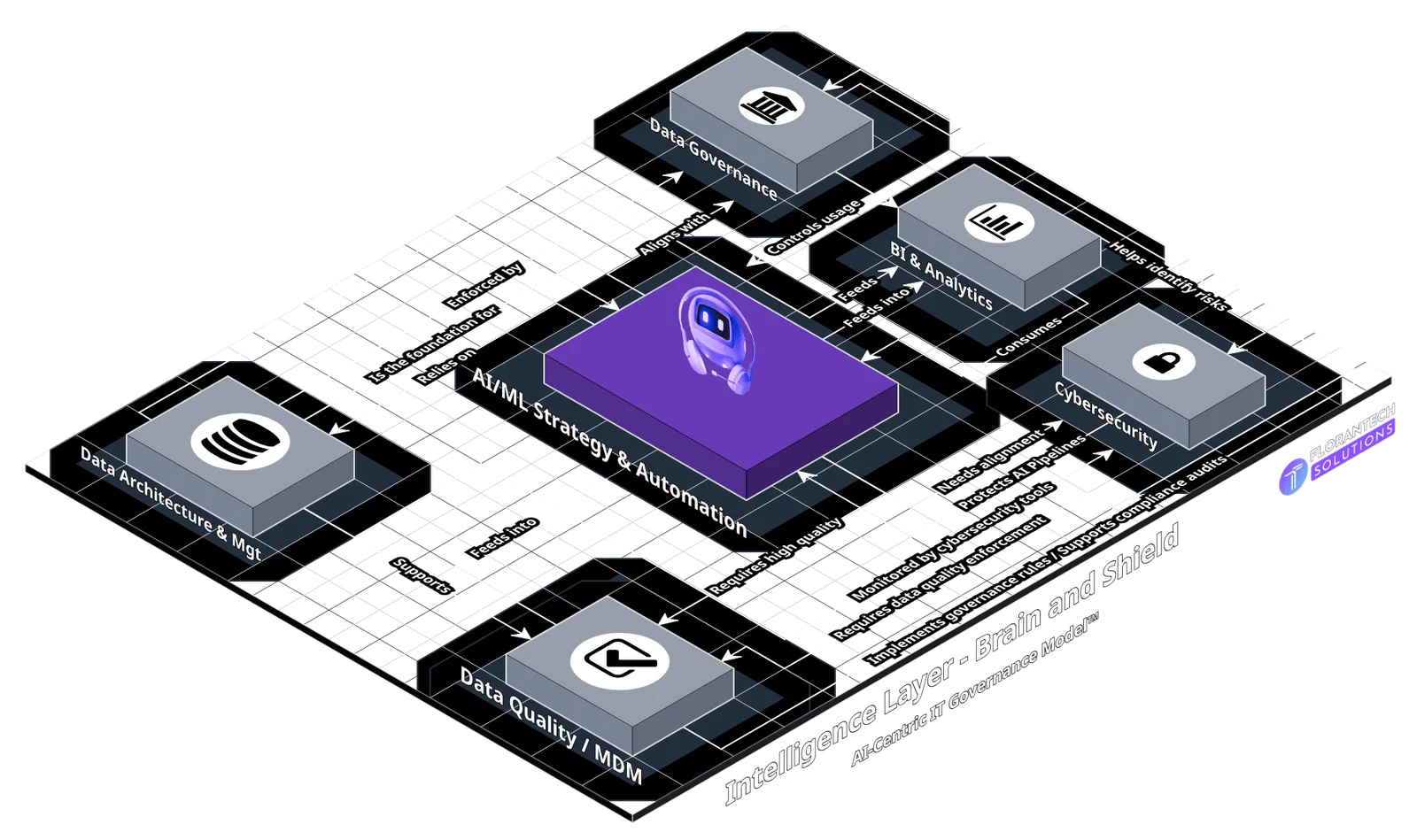
Layer 3 Focus Areas
AI/ML Strategy and Automation
L3-FA-01
Model development, MLOps, deployment pipelines, drift detection, bias and fairness testing.
Data Architecture and Management
L3-FA-02
Lakes, warehouses, structured and unstructured data design.
Data Quality and Master Data Management
L3-FA-03
Accuracy, consistency, lineage, mastering. Fitness determination covers data reaching a model through an interface, not only data held in a store.
Data Governance Operations
L3-FA-04
Classification, retention execution, consent enforcement, ethical AI controls in operation.
Business Intelligence and Analytics
L3-FA-05
Dashboards, reporting, predictive analytics.
Cybersecurity Strategy and Threat Management
L3-FA-06
Cyber defense, threat intelligence, SOC operations.
Privacy & Security Engineering
L3-FA-07
Technical implementation of ISO 27001, NIST, GDPR, HIPAA and PCI-DSS requirements: minimization, pseudonymization, encryption at rest and in transit, consent enforcement, logging.
Identity and Access Management
L3-FA-08
SSO, MFA, role-based access control, privileged access.
Security Operations and Incident Response
L3-FA-09
SIEM, forensic analysis, response execution.
Vulnerability Management
L3-FA-10
Continuous assessment, penetration testing, remediation tracking.
Why it matters for AI
A model is only as good as the data it learns from and only as safe as the controls around it. Layer 3 produces the evidence that Layer 4 verifies.
Layer 4
Control
The Control Tower
Who is accountable?
Set policy, allocate accountability, decide risk and verify that required controls operated.
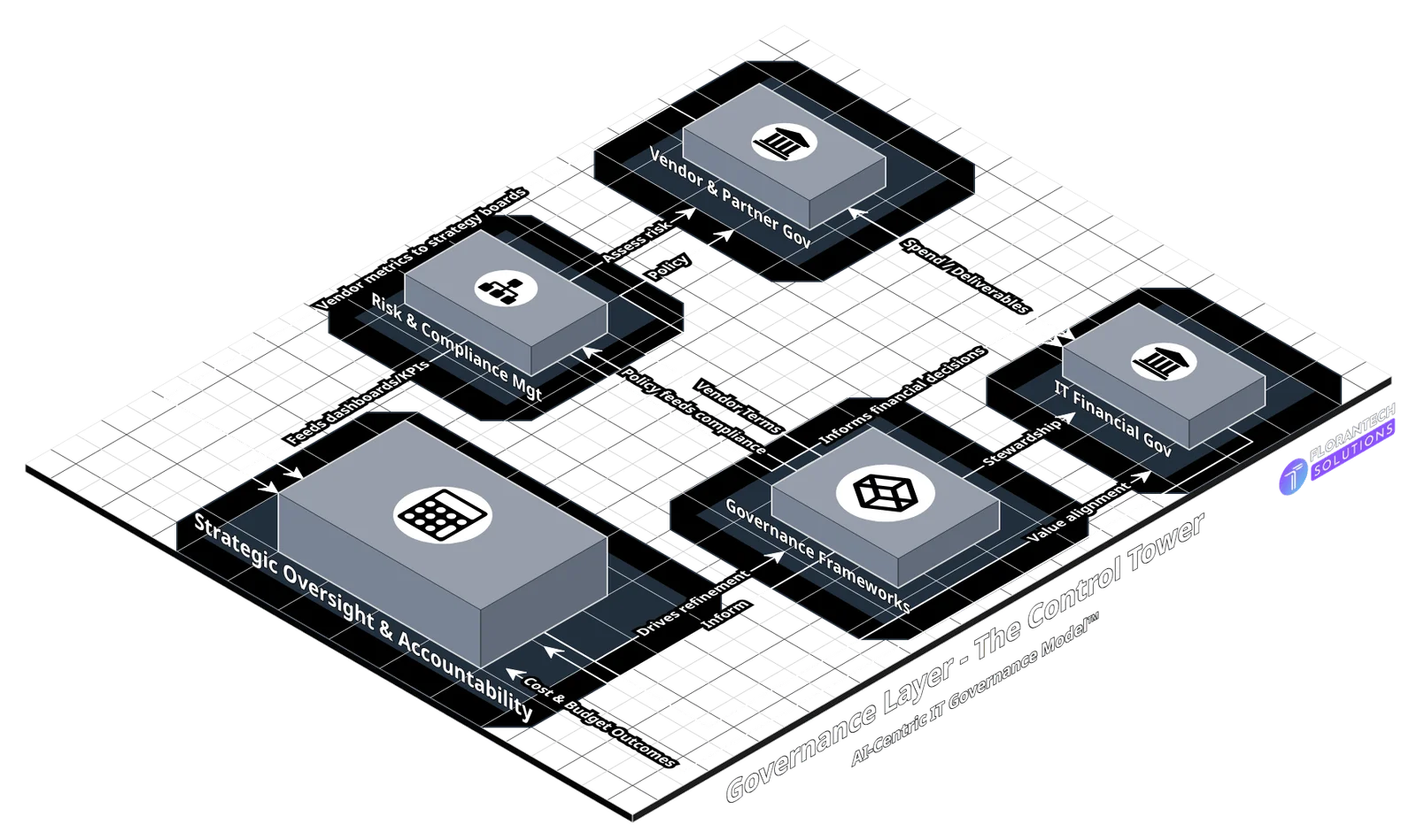
Layer 4 Focus Areas
IT and AI Governance Frameworks
L4-FA-01
COBIT, ITIL, ISO/IEC 38500, ISO/IEC 42001 adoption decisions.
Policy Development and Enforcement
L4-FA-02
AI policy, standard operating procedures, the mandatory control catalog.
Auditing and Reporting
L4-FA-03
Internal and external audit, evidence review, attestation, board and executive reporting, IT ethics.
Risk Management
L4-FA-04
Enterprise and AI risk assessment, risk appetite, mitigation planning, residual risk acceptance, AI system classification.
Compliance Management
L4-FA-05
Regulatory interpretation and adherence determination across SOX, GDPR, HIPAA, PCI-DSS, ISO/IEC 42001 and the EU AI Act. DPIA sign-off and regulator liaison.
IT Budgeting and Cost Optimization
L4-FA-06
CapEx and OpEx, chargeback and showback.
Cloud and SaaS Cost Management
L4-FA-07
Usage optimization, cloud cost governance, model training and inference cost accountability.
Technology Investment Planning
L4-FA-08
ROI analysis, emerging technology investment appraisal.
Procurement and Contract Management
L4-FA-09
Vendor negotiation, service levels, licensing, model licensing and training-data provenance terms.
Vendor Risk Management
L4-FA-10
Vendor security, compliance and performance assessment.
Strategic Oversight and Accountability
L4-FA-11
Named ownership per AI system, decision gates, escalation paths, ethics review, metrics tied to business goals.
Why it matters for AI
Without Layer 4, AI produces uncontrolled cost, legal exposure and unaccountable decisions. Every control Layer 3 runs exists because Layer 4 required it.
Layer 5
Execution
The Leadership Engine
Can it be built?
Convert authorized intent into delivered capability through sequencing, delivery discipline and the people who do the work.
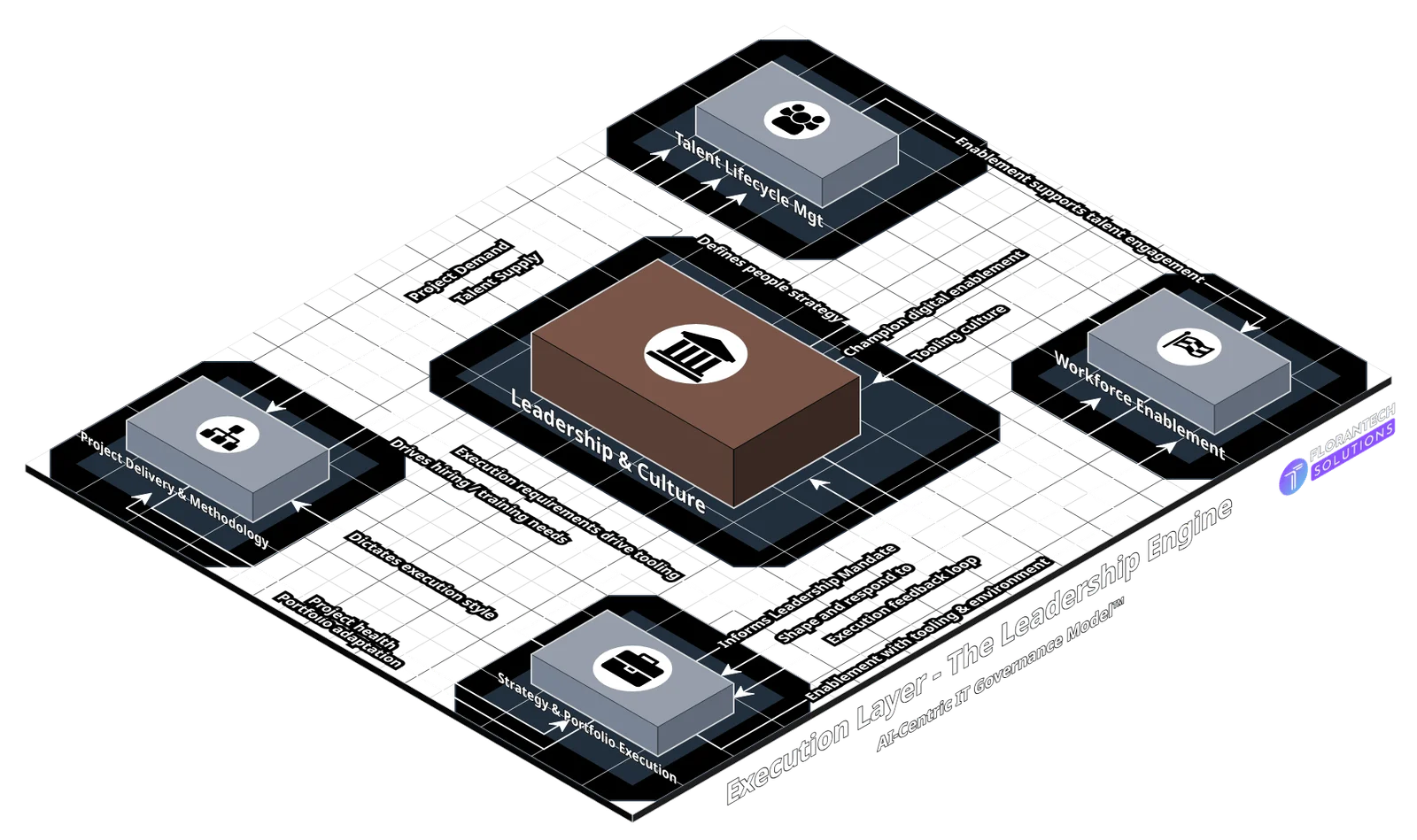
Layer 5 Focus Areas
IT Portfolio Management
L5-FA-01
Alignment of initiatives to business goals, prioritization.
PMO and Delivery Governance
L5-FA-02
Execution policy, delivery risk mitigation.
Change Management and Digital Adoption
L5-FA-03
Delivery Methodologies
L5-FA-04
Agile, waterfall and hybrid selection. Where AI assists development, delivery governance is held by STRATA Protocol and its phase-gated execution loop at Stratum 4. STRATA is not a fourth option alongside agile, waterfall and hybrid. It sits above the methodology choice and governs how a copilot operates inside whichever one is selected. An organization running agile with AI assistance runs both.
Resource and Capacity Planning
L5-FA-05
Staffing, skills allocation.
KPIs and Performance Metrics
L5-FA-06
OKRs, critical success factors, delivery measures.
IT Leadership and Culture
L5-FA-07
CIO, CTO, CAIO and CISO leadership, executive alignment, innovation tone.
Talent Acquisition and Development
L5-FA-08
Hiring, training, succession, retention, AI literacy.
Workforce Collaboration and Productivity
L5-FA-09
Tooling, hybrid work enablement, human and AI task allocation.
Why it matters for AI
Execution determines whether AI becomes delivered capability or sunk cost.
Layer 6
Strategic
The Enterprise Compass
Should it be built?
Decide which AI capabilities the organization should hold, why, and what governance capability it must build to hold them responsibly.
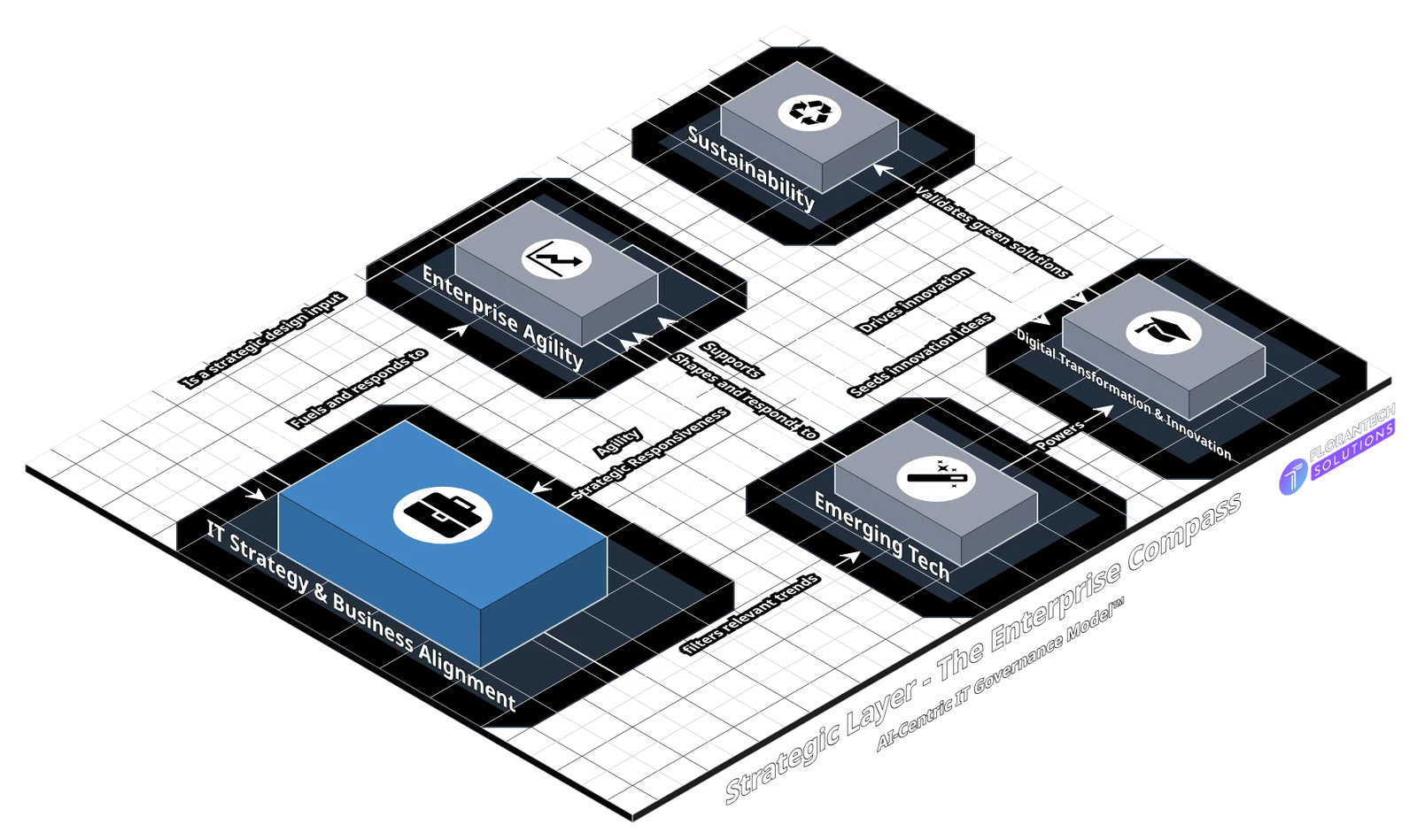
Layer 6 Focus Areas
IT Strategy and Business Alignment
L6-FA-01
Emerging Technologies and Trends
L6-FA-02
AI, quantum computing, blockchain, edge computing evaluation.
Digital Change and Innovation Labs
L6-FA-03
Prototyping, research, new business model testing.
Enterprise Agility and Competitive Advantage
L6-FA-04
Sustainability and Green IT
L6-FA-05
Energy and carbon accountability for training and inference.
Why it matters for AI
Layer 6 decides what should be built. Without it, the five layers below execute efficiently in no particular direction.
At maturity Level 2, a small organization maintains roughly a dozen documents, not seventy-one artifact types. See the minimum viable set.
Correction
The maintainer answers corrections. There is no service level. Responses are best-effort and opportunistic within a reasonable time: a correction raised on a Monday is answered that week or sooner.